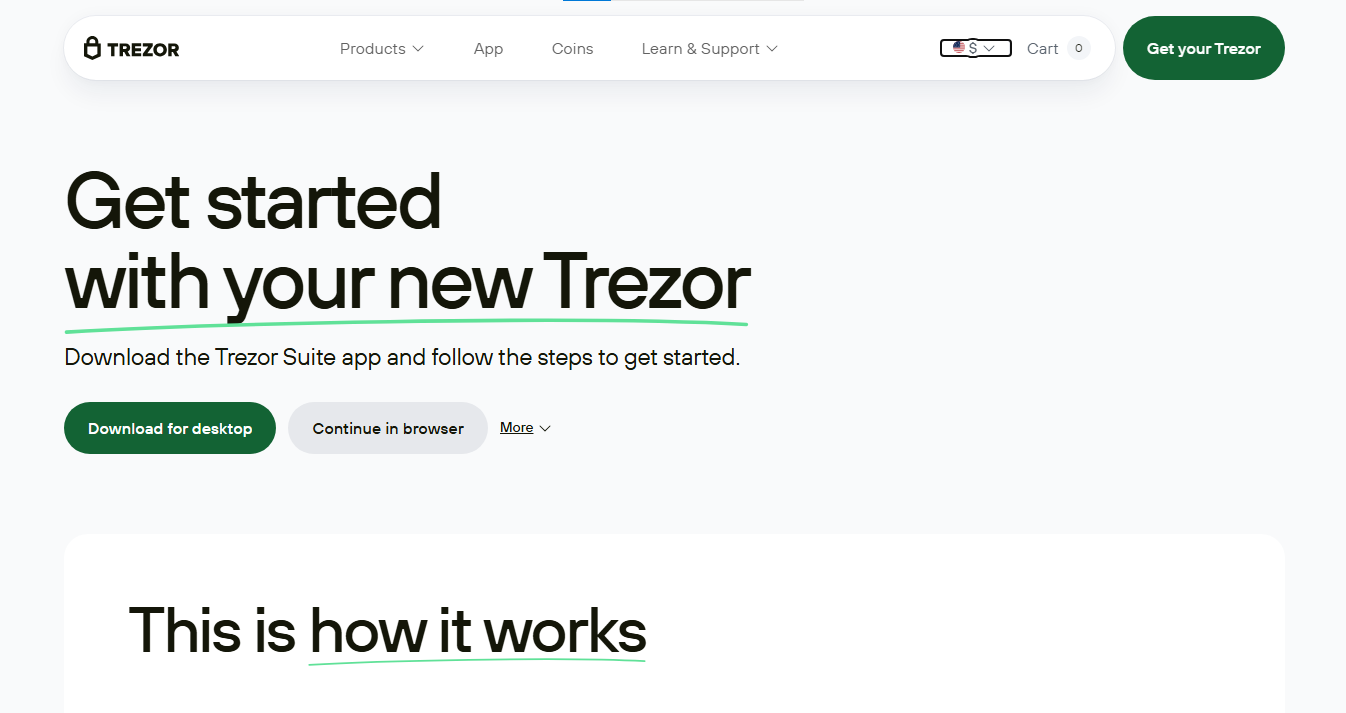
Trezor Suite — The Complete Guide to Secure Crypto Management With Hardware Wallets
Discover how Trezor Suite centralizes portfolio management, enables safe transactions, integrates with hardware verification, and leverages cold storage, deterministic wallets, and offline signing to keep your assets safe.
What Trezor Suite Is — And Why It Matters for Crypto Security
Trezor Suite is a powerful desktop interface designed to work with Trezor hardware wallets.
Unlike a typical software wallet, it does not store private keys or handle signing operations.
Instead, it offers a clean dashboard where users monitor balances, manage accounts, and initiate transactions while the hardware device performs offline signatures, cold-storage isolation, secure-element verification, and elliptic curve cryptography.
This architecture keeps keys protected even if your computer is unsafe, because signing still requires physical approval on the hardware wallet.
Unlike a typical software wallet, it does not store private keys or handle signing operations.
Instead, it offers a clean dashboard where users monitor balances, manage accounts, and initiate transactions while the hardware device performs offline signatures, cold-storage isolation, secure-element verification, and elliptic curve cryptography.
This architecture keeps keys protected even if your computer is unsafe, because signing still requires physical approval on the hardware wallet.
Core Capabilities Inside Trezor Suite
With Trezor Suite you can:
- View multi-chain portfolios in one dashboard
- Send and receive assets with hardware verification
- Install and update coin applications
- Upgrade firmware safely
- Interact with decentralized applications using secure signing
A User Story — When Security Becomes Tangible
During her first transfer, Lia expected a popup on her laptop.
Instead, the approval appeared only on the Trezor device.
After pressing the physical button, she realized:
**No software, no malware, no remote script can sign a transaction unless the hardware physically approves it.**
This moment shows why hardware wallets remain one of the most trusted self-custody solutions.
Instead, the approval appeared only on the Trezor device.
After pressing the physical button, she realized:
**No software, no malware, no remote script can sign a transaction unless the hardware physically approves it.**
This moment shows why hardware wallets remain one of the most trusted self-custody solutions.
How Trezor Suite Works With the Hardware Wallet
1. The Interface Displays Public Information
Balances and transaction history appear on your desktop.
2. Private Keys Stay Inside the Device
They never leave the secure chip and never touch the internet.
3. Signing Occurs Offline
Cryptographic signatures are generated without any network exposure.
4. Physical Confirmation Is Required
Buttons and screen protect against phishing and spoofing.
Security Principles Behind Trezor Suite
Trezor uses multiple defensive layers:
- Secure microcontrollers with anti-tamper design
- Cold storage key isolation
- Offline cryptographic signing
- Physical verification screens
Security Comparison
| Wallet Type | Security | Key Control | Ideal For |
|---|---|---|---|
| Trezor + Suite | Very High | User | Long-term storage |
| Mobile Wallet | Medium | User | Daily use |
| Exchange Wallet | Low | Exchange | Trading |
Best Practices for Using Trezor Suite
✔ Use only official Trezor Suite software
✔ Never share your recovery seed
✔ Confirm every action on the hardware device
✔ Back up your seed offline
✔ Keep firmware updated
✔ Never share your recovery seed
✔ Confirm every action on the hardware device
✔ Back up your seed offline
✔ Keep firmware updated
Frequently Asked Questions
1. Does Trezor Suite store private keys?
No — keys remain inside the hardware wallet.
2. Can malware sign transactions?
No — physical confirmation is required.
3. Does it support many cryptocurrencies?
Yes — hundreds across multiple networks.
4. Is it safe?
Extremely — thanks to offline signing and verification.
5. How do I restore?
Use your recovery seed on a new Trezor device.
No — keys remain inside the hardware wallet.
2. Can malware sign transactions?
No — physical confirmation is required.
3. Does it support many cryptocurrencies?
Yes — hundreds across multiple networks.
4. Is it safe?
Extremely — thanks to offline signing and verification.
5. How do I restore?
Use your recovery seed on a new Trezor device.
Conclusion — Trezor Suite Combines Usability With Strong Hardware Protection
Trezor Suite provides a smooth interface while the hardware wallet performs the secure work.
Offline signing, secure chips, deterministic key structures, and physical verification protect your assets even in hostile environments.
When paired with responsible custody habits, this ecosystem offers one of the strongest security models available today.
Trezor Suite gives you control, simplicity, and confidence — while the hardware keeps your keys safe at the deepest level.
Offline signing, secure chips, deterministic key structures, and physical verification protect your assets even in hostile environments.
When paired with responsible custody habits, this ecosystem offers one of the strongest security models available today.
Trezor Suite gives you control, simplicity, and confidence — while the hardware keeps your keys safe at the deepest level.